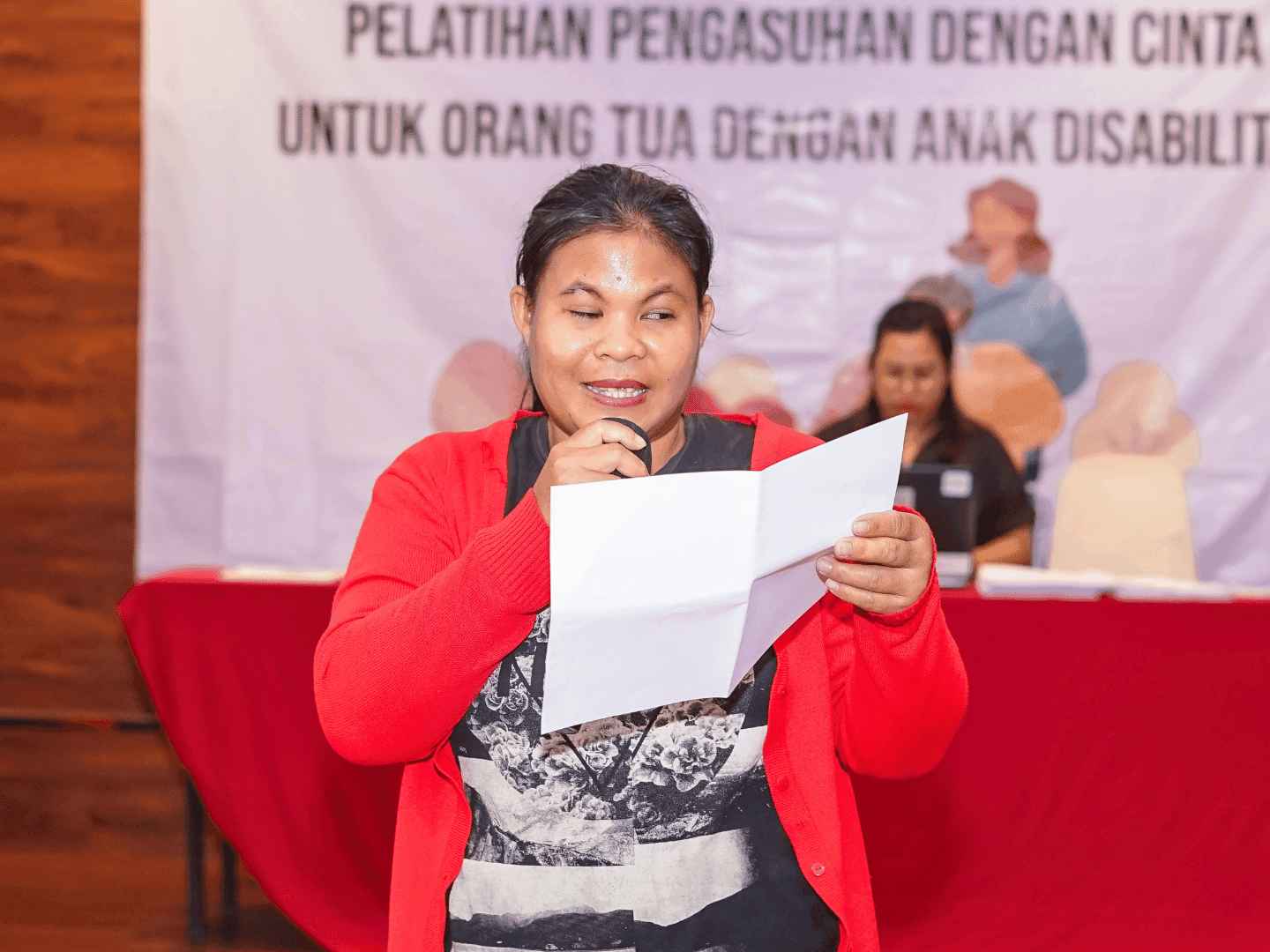
Stigma towards children with disabilities remains prevalent in Bengkayang Regency, West Kalimantan. Communities, and often even close family members, regard children with disabilities as a punishment from God. This perception became deeply rooted in the heart of Lusiana (34), a mother of three children with visual impairments, who once felt that God had treated her unfairly.
“I used to feel as though I was always unlucky. Since childhood, I have had difficulty seeing. I was also often subjected to violence by my own family. The scars are still visible today. After I got married, I gave birth to three children who have the same visual impairment as I do. I thought they did not need to go to school. Even our close relatives kept their distance from us, so how could I expect people at school to accept them? I felt as though God was playing games with me,” she recalled.
Breaking free from the grip of stigma requires acceptance, followed by gaining insights and understanding that may never previously have come to light. Lusiana began her journey beyond disability stigma through support from Wahana Visi Indonesia (WVI).
Working alongside faith leaders, WVI’s Bengkayang operational area organised parenting training sessions for parents of children with disabilities. Lusiana was one of the participants. The most important lesson she learned was how to come to terms with her own circumstances and to see children with disabilities as a gift from God, just like any other child.
In addition, Lusiana and 18 other parents gained a deeper understanding of disability, learned how to recognise the unique potential in every child, and practised positive parenting approaches at home. The support did not end there. Upon returning to her village, Lusiana became actively involved in regular parents’ meetings, where members shared their experiences and strengthened one another.
“Although my family is poor, I prioritise my children’s education. I send them to school because it is their rights, despite their disabilities. I have become more grateful for the life we have. There is always something positive I can see in each of my children. Our relationship has become much closer,” she said.
Today, Lusiana has a new perspective. Her children are no longer seen as a punishment, but as a blessing. The stigma directed towards her family is no longer a barrier to protecting and fulfilling her children’s rights.
“Mum now encourages us to pray together every evening. She never stops reminding us to study hard at school. She also teaches us to be confident. We may have barriers, but we have strengths too,” said Rafael (14), Lusiana’s second son.
Author: Sebastianus Rengga (Area Programme Manager in Bengkayang)
Editor: Mariana Kurniawati (Communication Executive)