
Child sponsorship programmes support educational guidance and mentoring through regular contributions, allowing programme implementation to be planned over the long term. In this approach, education forms a key part of supporting a child’s growth and development alongside their family and wider community.
Because of this, child sponsorship programmes do not merely focus on short-term relief, but on structured guidance delivered in phases according to the specific needs of each supported region. It is important to understand that sponsorship funds are not given directly as a cash donation to an individual child; rather, they are used to fund programmes that benefit the child and the environment in which they grow up.
We believe that sustainable support is an essential approach to creating an environment that fosters a child's learning process. To achieve this goal, programmes must be planned, monitored, and evaluated on a regular basis.
What Makes Child Sponsorship Programmes Sustainable?
Simply put, a child sponsorship programme is a long-term initiative supported through regular contributions from sponsors. This approach enables organisations to plan activities with far greater continuity than programmes relying solely on one-off support.
In practice, the programme does not focus exclusively on the child's immediate needs, but actively involves their family and community. This model is rooted in the understanding that a child’s development is shaped by the environment in which they live, learn, and grow every day. Consequently, programme activities often span multiple sectors to support the holistic wellbeing of the child.
Regular Support Aids Programme Planning
Routine contributions provide organisations with a more predictable foundation for executing programmes. With sustained support in place, activities can be structured in planned phases and tailored to the evolving needs of the supported area.
However, it is vital to recognise that regular financial support does not automatically guarantee specific outcomes. The success of any programme remains dependent on several factors, including the quality of planning, implementation, ongoing monitoring, and periodic evaluation. Sound programme management is therefore essential to ensure that contributions are used effectively in line with the programme’s objectives.
Mentoring Involves the Child’s Wider Environment
Children do not grow and learn in isolation. The condition of their family, school, and local community directly influences their education and personal growth. For this reason, child sponsorship programmes generally adopt a holistic approach that engages key stakeholders around the child.
Support may include initiatives that strengthen families, build community capacity, or foster a safer, child-friendly environment. This strategy aims to create sustainable conditions that support long-term education and development, rather than offering isolated assistance in just one area.
The Role of Child Sponsors in Supporting Education
Education is a primary focus within child development programmes. However, educational support does not always take the form of direct tuition fee payments. Instead, programmes encompass a range of initiatives designed to help children access better learning opportunities tailored to local needs.
Through this structured approach, the benefits of child sponsorship extend beyond classroom learning, encompassing broader efforts to build a more supportive learning environment.
Helping Children Engage in Learning
Educational support within a sponsorship programme can take various forms, depending on the specific goals and needs of the project. Based on our programmatic approach, support may include establishing or improving learning facilities, running literacy initiatives, providing academic mentoring, or facilitating skills development to aid a child's education.
Because every region faces unique challenges, the exact activities delivered will vary. Prospective sponsors are encouraged to review official programme details to fully understand the scope of support provided.
Building a Stronger Environment for Learning
A child’s educational success is deeply affected by factors outside the classroom. Health status, child protection, family support, and a safe environment all influence a child’s ability to learn effectively.
Through a community-based approach, child sponsorship programmes work to strengthen these interconnected areas. Education is not treated as an isolated issue, but as a core component of creating an environment where children can thrive in every aspect of their lives.
Key Differences Between Child Sponsorship and General Donations
Both sponsorship and general donations are valuable ways to support social initiatives. The main differences lie in how the support is delivered, the scope of the programme, and the level of commitment involved. Understanding these distinctions will help you decide which form of giving best aligns with your personal goals and financial capacity.
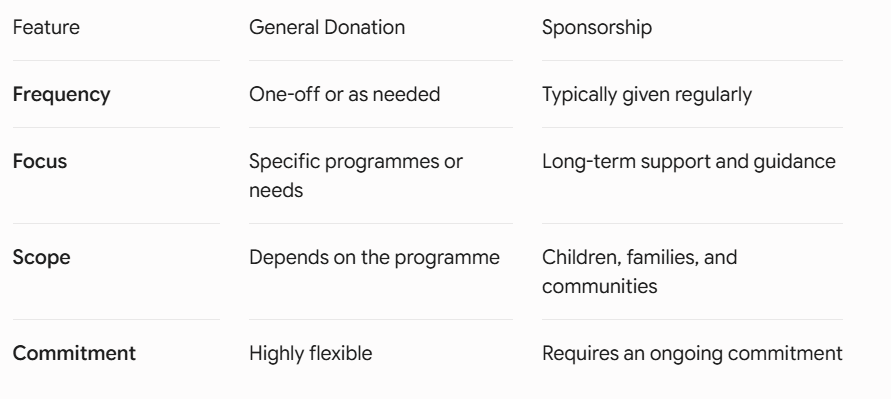
These distinctions demonstrate that sponsorship is not merely about the frequency of contributions, but also about a mentoring and guidance approach designed to foster gradual, long-term change. Therefore, before choosing to become a sponsor, it is essential to understand the nature of the programme and the commitment required.
Sponsorship Requires Readiness to Commit
Because it is typically carried out on a regular basis, sponsorship requires a willingness to provide support over a sustained period. However, this readiness is not measured by the size of the donation, but by your ability to maintain contributions comfortably within your financial means.
Before joining a child sponsorship programme, take time to consider the following:
Whether your monthly budget allows for regular contributions;
An amount that can be sustained without compromising your essential living expenses;
The expected duration of your support; and
The terms and conditions of the programme, including details on altering or cancelling sponsorship.
By considering these aspects, you can make a well-informed decision. This approach also helps ensure that sponsorship remains a comfortable and sustainable form of support for you.
Donors Must Understand How Support Is Used
In addition to assessing your commitment, prospective sponsors should understand how their contributions are managed. Organisations that run these development programmes generally provide clear information on programme goals, operational approaches, and implementation reports as part of their public accountability.
Reviewing this information gives prospective sponsors a clear overview of how the programme works, the scope of support provided, and ongoing progress. Consequently, your decision to join is grounded not only in a desire to help, but also in a clear understanding of how contributions actively support the programme.
How to Assess the Impact of Educational Mentoring
Before deciding to become a sponsor, it is good practice to evaluate how a programme demonstrates its impact. This assessment does not need to be overly complex, but it should be based on official information published by the organisation.
Key elements to look for include:
Clearly defined programme goals, helping you understand the intended outcomes;
Programme reports, offering an overview of activities implemented during a specific timeframe;
Progress indicators, showing achievements or results aligned with established targets; and
Programme updates, such as articles or case studies outlining developments in supported communities.
By reviewing these resources, you can determine whether a programme adopts a structured approach, undergoes regular monitoring, and operates with full accountability. This step also enables you to understand the benefits of child sponsorship based on objective data rather than promotional materials alone.
Learn About the Programme Before Becoming a Child Sponsor
You now understand that child sponsorship is a long-term guidance and development model that engages children, families, and wider communities. You also know that education forms a key pillar of this approach, alongside other essential factors that support a child’s holistic development.
Before making your decision, we encourage you to explore detailed information regarding the sponsorship process, the scope of support, child selection options available under the programme guidelines, and other official details. Understanding how the programme works upfront will help you determine whether sponsorship is the right form of contribution for your goals and readiness.
Now that you understand how sponsorship supports sustainable education, explore Wahana Visi’s Child Sponsorship Programme and choose a level of support that suits your readiness.