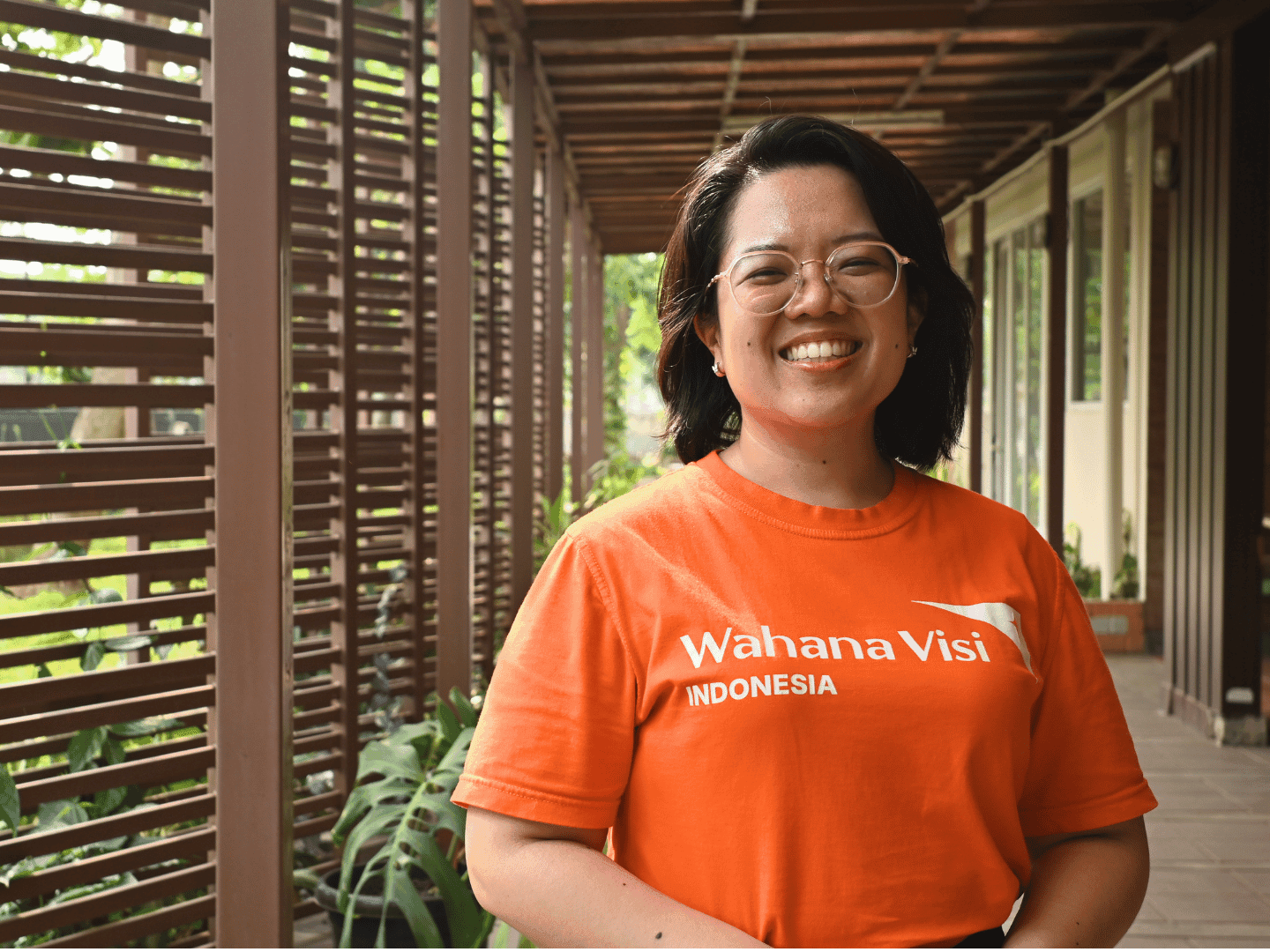
A short phrase, “every child”, found in the vision statement of Wahana Visi Indonesia (WVI), holds profound meaning for Anita. For the past eleven years, her career journey has revolved around these two words. As a Gender, Disability, and Social Inclusion (GEDSI) Specialist, she has learned so much from the idea of “every child”. Every child is different, yet none should be treated differently. Within that phrase are girls and boys, children with and without disabilities, children from diverse cultural and linguistic backgrounds.
For Anita, her work in the humanitarian sector is an answered calling that has led her to understand the importance of every child. Over the past eleven years, she has witnessed many simple realities. Yet it is precisely through these experiences that she has grown, just as the children she has met in WVI-supported communities have grown.
Spinach Soup from a Humble Kitchen
“Through this experience, I began to see the world differently,” Anita recalled. The experience she referred to was a live-in programme with residents of a village in Central Java. This moment, which took place when she was still in secondary school, became her first connection to the humanitarian world. It took her beyond the bubble of life she had always known.
“While staying with a host family in the village, I helped cook spinach soup. It was a simple meal I had never encountered before, prepared in a kitchen that still used a wood-burning stove,” she explained. At that moment, Anita realised that there were communities living in ways very different from her everyday experience. Homes without paint, floors without tiles, yet within them lived families who embraced life with simplicity and dignity.
When she returned home to Bandung, life resumed its usual rhythm, but through a different lens. She went back to school, then university, and eventually came to know WVI, though not initially as a staff member. Her first connection was as a Child Sponsor.
“My two older sisters and I pooled our money to sponsor three children. At the time, I was still at university, so I had to set aside part of my pocket money for the donations,” said the self-confessed food enthusiast. Becoming a Child Sponsor allowed Anita to remain connected to the values of simplicity and humility, while also playing a role in the life of a child living far away.
Anita joined WVI as part of its Management Trainee Programme in 2015, shortly after graduating from university. She later served as a Monitoring and Evaluation Coordinator in the operational offices of Kubu Raya, West Kalimantan, and Jakarta. Her career developed through analysing field data and gaining insight into the realities faced by children and families.
These experiences became the foundation for her next role as a Programme Officer at the national office in 2021. They provided her with rich perspectives as she managed programme proposals and communicated with WVI’s global partner, World Vision.
In 2026, Anita began a new and more specialised chapter of her career. As a GEDSI Specialist, she works to create more equitable and inclusive opportunities for every child to grow and thrive.
Having served in various roles, Anita likens WVI to a binder. “You can probably tell which generation I belong to because I still use binders,” she laughed. “But what I mean is that a binder’s contents can be replaced while the cover remains the same. I’m a bit like that. The chapters have changed, but the cover is still WVI.” Within that cover, she has grown. Within it, she has found her calling.
Encountering Differences
Anita began her work at WVI by listening more than speaking. Together with colleagues in Kubu Raya and Jakarta, she visited many children and families who shared stories of their lives. Every story was unique. None was better or worse than another.
These experiences taught Anita that encountering differences cultivates humility. “Everyone has their own experiences and wisdom. That means we can never assume that we know best. In fact, the moment we think we know everything is the moment we realise we know nothing at all.”
This became a turning point in Anita’s life, transforming her into someone very different from who she had been before joining WVI. Her humility continued to grow through listening to thousands of stories from other people. “There is always something we can learn from one another,” she added.
Her experiences supporting children and families in some of the most remote communities exposed her to many forms of vulnerability. Although these experiences often broke her heart, they strengthened her commitment to remain present and continue walking alongside them.
“Yet I’ve also experienced incredibly rewarding moments. Moments when I meet children again who once seemed withdrawn and uncertain about themselves, only to find that they have become young people who know their purpose, understand their dreams, recognise their talents, can speak up, and fight for their rights. Their eyes sparkle. There is passion in the way they speak.”
On Discrimination and Equality
Anita carries the stories she has gathered from the field and uses them as an anchor for the work she does today. Through the lens of her current role, she believes that society needs to pay greater attention to discrimination, particularly because children are central to efforts promoting gender equality and social inclusion.
“Indonesia’s national motto, Bhinneka Tunggal Ika (Unity in Diversity), actually reflects the principles of gender equality and social inclusion very well. We are different, yet we remain one. Unfortunately, social and economic inequalities often divide that unity. People begin to discriminate against one another, even though human beings are naturally diverse.”
As a woman of Chinese-Indonesian heritage, Anita believes there is no value in treating people differently. Such behaviour only highlights humanity’s tendency to make assumptions, acting as though one person fully understands what another needs or feels. In situations like these, children often have little opportunity to speak, let alone be heard.
Achieving zero discrimination and genuine equality, for children and other marginalised groups alike, requires thoughtful and strategic action. In her current role, Anita provides technical support to help community development programmes become more responsive to issues of gender equality and social inclusion. Yet beyond technical expertise, Anita seeks to connect with people in a genuine and human way.
“It’s something very simple that I feel is becoming increasingly rare, even though it can help eliminate discrimination. Greet people, say hello, look them in the eye, start a conversation, exchange ideas. That’s when a more equal environment begins to take shape. We listen to one another. We stop making assumptions. We stop pretending to know what someone else is thinking, whether they are a child or an adult.”
Years after beginning her journey of understanding what “every child” truly means, Anita continues to carry the same conviction: that meaningful change often begins with a willingness to sit down, listen, and see every child as an equal individual.
Author: Mariana Kurniawati (Communication Executive)