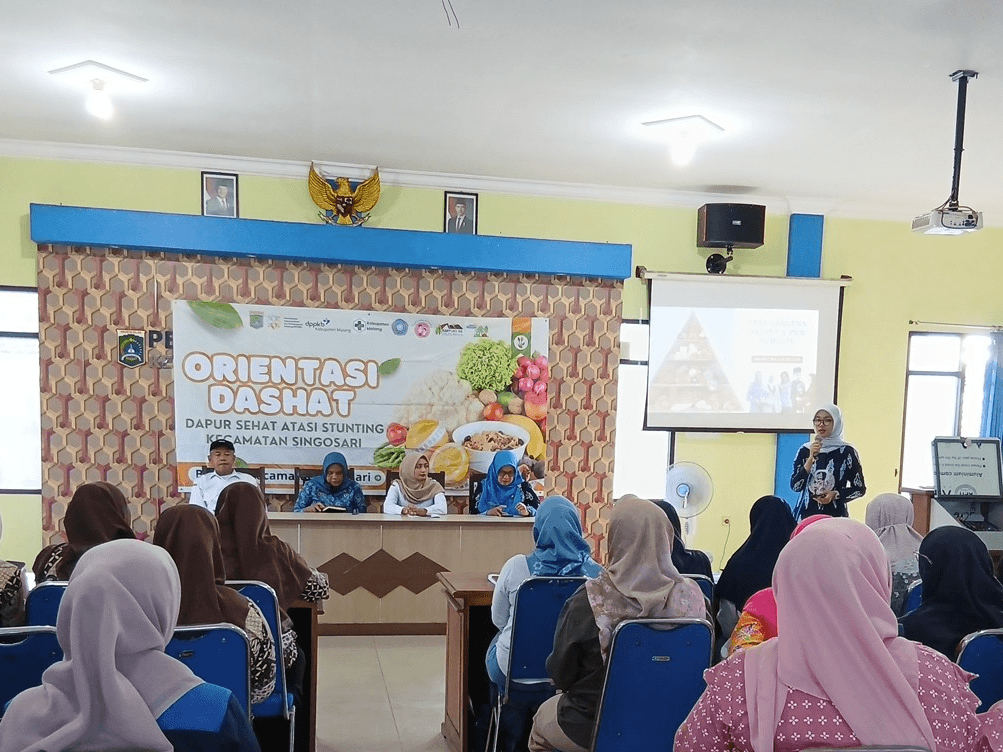
PASTI Program was launched in Malang Regency in 2023 as part of an accelerated effort to prevent and reduce stunting. One of the core approaches developed was Pos Gizi DASHAT (PGD). This initiative integrates the Positive Deviance-based Nutrition Post (Pos Gizi) approach—long developed by Wahana Visi Indonesia—with the Healthy Kitchen to Overcome Stunting (Dapur Sehat Atasi Stunting or DASHAT) concept initiated by BKKBN. This framework focuses not only on fulfilling nutritional needs but also on driving long-term behavioral changes in parenting and feeding practices at both family and community levels.
At that time, the implementation of DASHAT by the Population Control and Family Planning Agency (DPPKB) across several Kampung KB (Family Planning Villages) in Malang Regency varied significantly. It lacked uniform standards regarding target groups, implementation mechanisms, educational materials, and monitoring systems.
Following the rollout of the PASTI Program's Pos Gizi DASHAT (PGD) in November 2023, DPPKB Malang Regency began to see a more systematic and structured approach to stunting prevention. This included clearly identifying families at risk of stunting, conducting initial health screenings, providing balanced nutritional menus, educating parents and caregivers, and tracking progress. The shared experience of mentoring and monitoring provided a clearer vision of how DASHAT could be run in a structured, measurable, and behavior-change-oriented manner moving forward.
"I am highly interested in replicating this in other villages and sub-districts, considering we now have a clear blueprint for the Pos Gizi DASHAT concept—even if, admittedly, not every component can be replicated fully, especially the feeding class approach," said Mrs. Chusnul from DPPKB Malang Regency.
Scaling Up and Standardization
Armed with these insights, DPPKB Malang Regency initiated a replication plan in 2024, adopting the Pos Gizi DASHAT (PGD) intervention approach through local budget allocations. Key components adopted included:
Training village cadres and community volunteers.
Selecting specific targets (specifically toddlers under two years old, or Baduta 1T).
Conducting baseline health screenings (Day 0).
Hosting educational classes and cooking demonstrations.
Utilizing DASHAT progress report cards.
Implementing DASHAT menus derived from Positive Deviance (PD) family menu findings from the PASTI Program.
Monitoring behavioral changes systematically on days 30, 60, and 90.
The turning point became evident in 2025. Moving beyond just a handful of locations, Malang Regency successfully scaled the implementation to 118 DASHAT Posts across various villages. Furthermore, several villages developed independent innovations, such as documenting DASHAT menus into short videos shared via WhatsApp groups as educational media for parents and caregivers. Other villages began allocating local village funds to strengthen the implementation, ensuring it remains well-targeted and sustainable.
A Regency-Wide Movement
This momentum was further amplified in 2026 through a regional budget (APBD) allocation of IDR 2.86 billion. The replication of Pos Gizi DASHAT was scaled up to cover 390 villages and sub-districts. Its execution involved a massive collaborative network, including DPPKB, the Health Office, TP PKK, village midwives, Family Planning Field Officers (PLKB), Family Companion Teams (TPK), and the Pos Gizi DASHAT volunteers previously trained under the PASTI Program.
The most significant shift for Malang Regency was not just the scale of execution, but the establishment of standardized procedures. Villages and sub-districts now share a unified reference for identifying target groups, delivering nutritional education, planning menus, and monitoring the progress of at-risk families.
"I am thrilled to share my experience in this DASHAT development training across 390 villages in Malang Regency. I feel proud that what I learned from the PASTI Program is now benefiting so many people. The Pos Gizi DASHAT menus we served daily are now being adopted by other villages. I have also been asked by several PLKB coordinators to facilitate training for cadres and volunteers who will implement DASHAT in their respective villages," shared Mrs. Devy, a Pos Gizi DASHAT volunteer from one of the PASTI Program's pilot villages.
What began as a localized learning experience in 29 pilot villages under the PASTI Program has blossomed into an institutionalized regional policy, reaching 390 villages and sub-districts across Malang Regency. This transformation beautifully demonstrates how grassroots best practices at the village level can successfully spark a massive, regency-wide movement.
PASTI (Partnership for Accelerating Stunting Reduction in Indonesia) is a collaborative programme between the Ministry of Population and Family Development/BKKBN, the Tanoto Foundation, PT Amman Mineral Nusa Tenggara (AMMAN), and PT Bank Central Asia Tbk (BCA). The programme is implemented by World Vision Indonesia as the lead implementing partner, with Yayasan Cipta serving as the sub-implementing partner.
Author: Dian Agustin and Christine Lora Egaratri (PASTI programme team member)