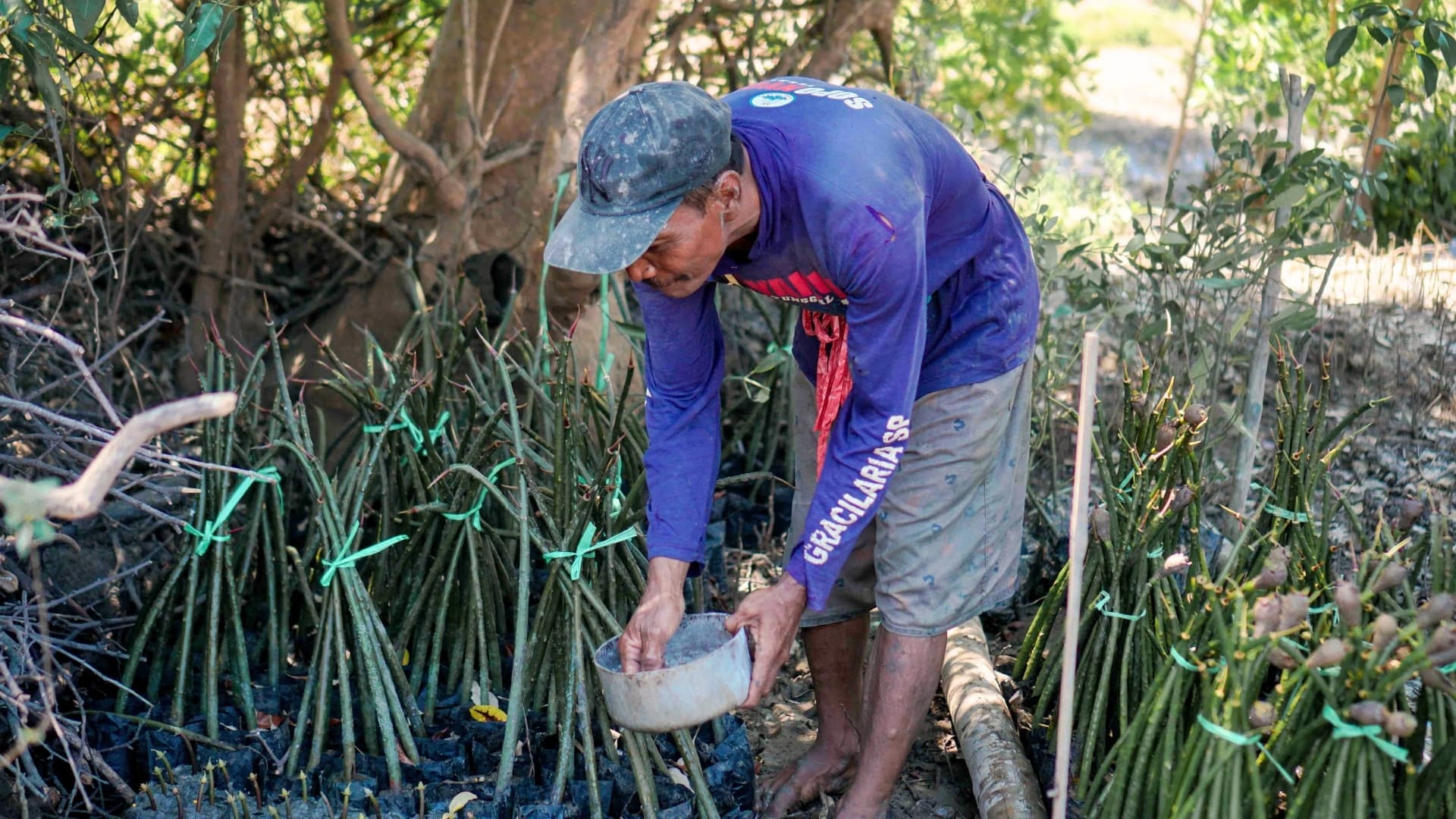
For over 30 years as a fish farmer, Harto (53) has faced various challenges in managing his ponds. However, a major shift began when he independently decided to plant mangroves around his site. This decision stemmed from a personal realisation after witnessing the increasing threat to the local environment.
The environmental conditions surrounding his ponds had changed drastically. He describes how a nearby river area underwent clearances that led to the loss of natural vegetation. Since then, the environment has felt much hotter, and the ponds have lost their natural balance. The fish no longer had shaded areas, which affected the overall condition of the ponds.
Furthermore, because there were no mangroves in this area of the Keputih sub-district in Surabaya, the pond embankments became more vulnerable. Harto experienced several breached embankments, resulting in failed harvests. This situation became a turning point for him to seek ways to make his ponds more resilient to environmental changes.
Through the guidance of Wahana Visi Indonesia (WVI) via the Mangrove Adaptive and Resilient Village for Enhanced Livelihoods by Adopting Sustainable and Environmentally-Friendly Aquaculture (MARVEL SEA) programme, Harto began to understand the function of mangroves. He learned proper mangrove nursery techniques and identified the specific species suitable for pond areas. This knowledge broadened his perspective, teaching him that mangroves are not just plants but a vital part of the pond ecosystem.
From this learning process, a new awareness grew within Harto. Without waiting for further instructions, he took the initiative to plant mangroves independently around his ponds. This decision marked a significant step, demonstrating a change in his outlook on the environment.
This initiative did face challenges. The mangrove seedlings he planted were often eaten by goats and crabs. Additionally, planting mangroves proved to be quite physically demanding. However, Harto persevered because he understood the long-term benefits of the trees.
As the mangroves began to grow, the benefits became apparent. They helped protect the pond embankments, and the surrounding environment started to improve. For Harto, this was not just about repairing the ponds but about ensuring the sustainability of his livelihood as a fish farmer.
“I realise now that without mangroves, the ponds are more vulnerable. These mangroves are like a shield—not just for the ponds, but for our future,” he said.
The transformation Harto experienced is deeply meaningful because it was born from personal awareness and initiative. He has not only seen a physical change in his ponds but also a change in how he adapts to environmental shifts.
Looking ahead, Harto hopes that more fish farmers will develop a similar awareness. He envisions a pond area that is greener, less arid, and capable of providing more profitable harvests.
Author: Santo Petrus (MARVEL SEA Project Coordinator)
Editor: Mariana Kurniawati (Communication Executive)