Understanding how to choose a child sponsorship programme involves more than simply comparing organisations; it requires aligning the initiative with your donation goals and personal readiness. Everyone has distinct motivations when supporting a child, meaning the most suitable option varies from person to person.
Before deciding, consider four key factors: your donation objectives, the programme's scope, your readiness for a recurring commitment, and the organisation's level of transparency. Evaluating these elements will help you select a programme tailored to your expectations and capacity.
We believe the choice to sponsor a child should be grounded in clear, accessible information rather than good intentions alone. Understanding how a programme operates from the start enables you to choose a form of support that is both meaningful and realistic.
Define Your Personal Child Support Goals
The first step in choosing a child sponsorship programme is defining the specific outcomes you hope to achieve. Individual concerns regarding child welfare vary. You may wish to support access to education, improve healthcare, enhance child protection, or strengthen families so children can grow in supportive environments.
Identifying your goals upfront helps narrow your options. If your primary focus is education, look for initiatives that clearly explain how academic mentoring and learning support are delivered. Similarly, if your focus lies in health, child protection, or family empowerment, ensure the programme aligns with those specific priorities.
Clarifying your objectives allows you to determine whether an organisation’s programmatic approach truly matches the impact you wish to foster.
Select the Issue Most Relevant to You
Once your goals are established, choose the issue that resonates most strongly with your values. Child sponsorship programmes feature different core focus areas, making it essential to understand their scope before committing.
For instance, some initiatives prioritize improving education quality, whereas others focus on healthcare, safeguarding children from risk, or strengthening family economies to create a stable upbringing.
No single issue holds greater importance than another; these factors are interconnected and collectively shape a child’s overall wellbeing. Choose a programme that aligns with your values and predefined giving objectives.
Determine Your Expected Form of Impact
Alongside selecting an issue, consider the specific type of impact you expect your contribution to make.
Some initiatives deliver immediate relief, whereas others employ long-term development and mentoring strategies over extended periods. Because these approaches serve different purposes, their outcomes naturally vary.
Before committing, verify whether the organisation clearly outlines the indicators and results it aims to achieve. This information explains how progress is measured and why certain systemic changes take time.
Setting realistic expectations is equally crucial. Mentoring and development programmes work through phased, gradual steps, meaning results do not always materialize overnight.
Understand the Scope of Child Sponsorship
Before joining as a sponsor, it is important to understand how sponsorship models function. Generally, child sponsorship provides structured support designed to foster child development through family and community engagement. Consequently, sponsor contributions fund broader community-based initiatives in the target area, rather than being disbursed as direct cash transfers to an individual child.
This community-focused strategy fosters a supportive, sustainable environment for a child’s growth through planned interventions tailored to local needs.
Review the Focus Areas
When evaluating a programme, examine its key areas of intervention. Based on official details regarding Wahana Visi’s Child Sponsorship Programme, core operational areas include:
Education: Enhancing learning access, literacy, and educational environments.
Health: Improving child nutrition, sanitation, and community healthcare access.
Child Protection: Establishing safe, supportive environments that safeguard children from harm.
Family Support & Livelihoods: Strengthening family economic resilience to ensure long-term child wellbeing.
These four pillars work together to support a child’s holistic development. Aligning these focus areas with your personal goals ensures your contributions address the issues you care about most.
Review the Steps to Become a Sponsor
In addition to understanding programme scope, review the general process for becoming a sponsor. Through Wahana Visi’s Child Sponsorship Programme, prospective sponsors can view available child profiles, select a child to support within the programme guidelines, and complete a registration form.
Following registration, the Wahana Visi team reaches out to provide detailed onboarding information and regular programme updates. Understanding this onboarding workflow upfront ensures a smooth transition into sponsorship.
Assess Your Readiness for a Regular Commitment
Because sponsorship relies on recurring contributions, assess whether a regular financial commitment aligns with your personal financial planning. Decisions rooted in long-term capacity are far easier to sustain than commitments that strain your budget.
Use this checklist to evaluate your readiness:
Stable Monthly Income: Your income reliably allows for regular charitable contributions.
Essential Living Costs Covered: Daily household expenses are fully secured without relying on donation allocations.
Protected Emergency Fund: Savings for unforeseen events remain untouched and separate from sponsorship funds.
Realistic Contribution Level: The monthly sum is comfortable and sustainable over an extended timeframe.
Clear Expectation of Duration: You understand that developmental mentoring is a long-term process requiring time.
Flexible Payment Terms: The organisation provides clear options for adjusting contribution amounts if your financial situation changes.
Straightforward Cancellation Policies: Procedures for pausing or ending sponsorship are transparent and easy to find should your circumstances evolve.
If you fulfill most of these criteria, you have a solid foundation for entering into a long-term sponsorship commitment.
Evaluate Transparency and Programme Updates
Evaluating organisational transparency is a critical step when choosing a sponsorship programme. Transparent operations demonstrate how projects are executed, how donor funds are managed, and how the organisation maintains public accountability.
Key indicators of organisational transparency include:
Clearly defined programme goals and target outcomes;
Transparent descriptions of beneficiary groups and operational scope;
Clear breakdowns of how financial support is managed and allocated;
Publicly accessible progress and financial reports;
Regular updates provided to sponsors regarding community developments;
Readily available contact details for donor support; and
Clear, upfront explanation of sponsorship terms and conditions prior to enrollment.
Reviewing these criteria ensures your decision rests on objective data and clear operational policies rather than initial impressions alone.
Align the Programme with Your Donation Goals
After clarifying your goals, assessing programme scope, confirming your financial readiness, and evaluating organisational transparency, synthesize this information to make your final choice.
Remember that giving decisions are deeply personal. A programme that suits one donor may not be the ideal match for another, as individual capacity, objectives, and expectations vary.
Use the following framework to guide your review:
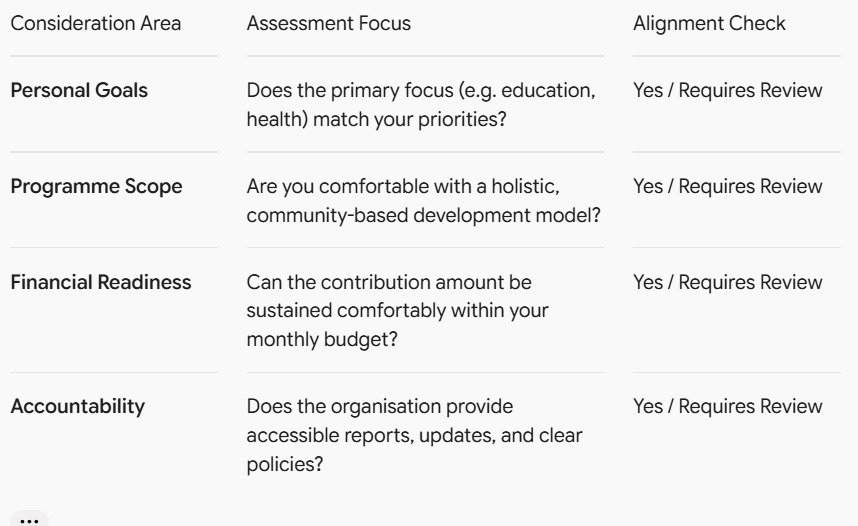
If these considerations align with your expectations, the sponsorship programme represents a viable pathway worth exploring. If certain aspects remain unclear, take time to gather additional details before committing.
Explore Wahana Visi’s Child Sponsorship Programme
Choosing a child sponsorship programme depends not on the size of a contribution, but on alignment between your goals, the programme’s scope, your financial readiness, and the organisation's operational transparency.
Before committing, explore the official details of Wahana Visi’s Child Sponsorship Programme. Take time to view available child profiles, review the onboarding process, examine our core focus areas, and read our latest progress reports. Equipping yourself with this information ensures your choice provides meaningful, sustainable support within your capacity.
Now that you know how to align a sponsorship programme with your giving goals, explore Wahana Visi’s Child Sponsorship Programme and choose a level of support that fits your readiness.