Every morning, Mrs. Odong begins her day as a farmer. But since becoming a volunteer with the PASTI Program, she has taken on another responsibility that she refuses to neglect: supporting pregnant women and parents of children under two through Pos Gizi DASHAT (PGD), a community-based nutrition activity.
For Mrs. Odong, 52, becoming a volunteer has not always been easy. She has to balance her work in the fields with her responsibilities as a community volunteer. The PGD location is also quite far from her home. She walks approximately 4–5 kilometers, leaving as early as 5:30 a.m. so that she can participate in the activities from beginning to end.
At first, Mrs. Odong hesitated to join. In addition to her responsibilities as a farmer, she has difficulty reading and writing at close range. However, with strong support from her husband and children, she decided to participate in volunteer training organized by Wahana Visi Indonesia through the PASTI Program.
Her motivation was simple: she wanted to help pregnant women and young children in her community. By gaining new knowledge, she could share it with others.
From Farmer to a More Confident Community Volunteer
Before learning about the PASTI Program, Mrs. Odong was already active as a Posyandu cadre in her village. Through PASTI volunteer training and her involvement in Pos Gizi DASHAT, however, she gained new knowledge and experience about health, nutrition, parenting, hygiene, and the preparation of nutritious food for pregnant women and children under two.
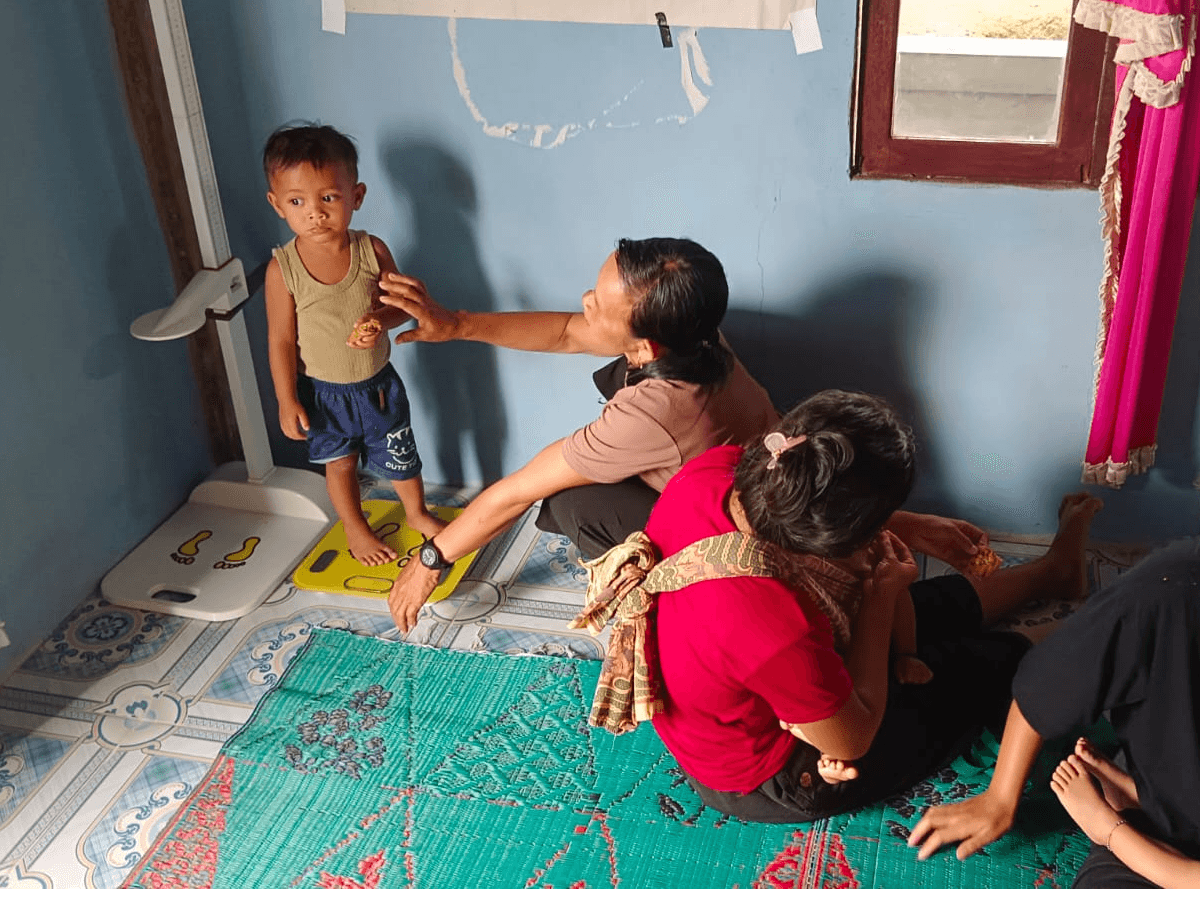
The PGD activities were conducted over 12 consecutive days. Pregnant women learned about nutrition and healthy eating habits, followed by health education sessions. Mrs. Odong did more than simply attend. She actively supported the sessions, monitored the weighing and measurement of participants, and shared simple health messages with pregnant women and parents of children under two.
She reminded families about the importance of healthy lifestyles, good parenting practices, and nutritious food, including vegetables, fish, meat, eggs, milk, and other sources of essential nutrients.
But the most significant change happened within Mrs. Odong herself.
Before joining the program, she had never provided education directly to pregnant women and parents of young children. After receiving training and gaining hands-on experience through PGD, she became more confident in speaking with families and sharing what she had learned.
Knowledge That Goes Beyond the Classroom
For Mrs. Odong, the knowledge she gained was not meant for her alone.
She began to see how her role as a volunteer could benefit the wider community. She sought to motivate other volunteers, share her experiences, and encourage families to pay greater attention to maternal and child health.
One of the things that makes her happiest is seeing parents enthusiastically bring their children to participate in PGD activities. Her interactions with fellow volunteers, together with support from the village government, have strengthened her belief that community involvement can create positive change.
Today, while continuing to work as a farmer, Mrs. Odong is increasingly motivated to share knowledge about nutritious food preparation, parenting practices, and hygiene with people in her community.
Becoming a Volunteer, Becoming an Agent of Change
Mrs. Odong’s journey shows that change does not always begin with someone who has abundant resources or formal education. Sometimes, it begins with a person who cares and is willing to learn.
From a farmer who initially hesitated because of her personal limitations, Mrs. Odong has become a more confident volunteer supporting pregnant women and parents of children under two.
She hopes more families will receive the information and support they need so that pregnant women can remain healthy and children have the opportunity to grow and develop well.
“After participating in the PASTI Program, especially through Pos Gizi DASHAT, I believe activities like this can be implemented in other areas and villages. The wider the reach, the more children, families, and communities can gain access to adequate nutrition and an environment that supports their well-being.”
A Hope for Sustainability
For Mrs. Odong, the end of a program does not mean the end of efforts to support her community.
She hopes that Wahana Visi Indonesia, particularly through the PASTI Program, can reach more communities because many pregnant women and children still need support. She also hopes more families will have access to sufficient information and resources to provide the best care and parenting for their children.
“What I have learned from this program is not something I want to keep to myself. I want to continue sharing this knowledge with mothers and other volunteers.”
For Mrs. Odong, every small step matters. Walking to the PGD location, sharing knowledge, and supporting families one by one are all part of a larger effort: ensuring that mothers and children in her community have the opportunity to live healthy lives and grow to their full potential.
PASTI (Partnership for Accelerating Stunting Reduction in Indonesia) is a collaborative programme between the Ministry of Population and Family Development/BKKBN, the Tanoto Foundation, PT Amman Mineral Nusa Tenggara (AMMAN), and PT Bank Central Asia Tbk (BCA). The programme is implemented by World Vision Indonesia as the lead implementing partner, with Yayasan Cipta serving as the sub-implementing partner.