
Supporting children’s education can be done through one-off or recurring donations. One-off donations provide greater flexibility, as they are made according to your needs or financial capacity at a specific time. In contrast, recurring donations are periodic contributions made according to a chosen schedule. Neither option is inherently superior, as each comes with its own advantages and considerations. Most importantly, your chosen donation pattern should align with your financial situation, donation goals, and readiness to commit over a specific timeframe.
For many people—especially young professionals who are just starting to give—deciding on the type of donation is often the first step before supporting an education programme. Understanding the differences between the two can help you choose a donation method that is more comfortable and sustainable within your means. This ensures that your contribution supports sustainable educational assistance without compromising your personal financial needs.
Recurring Donations Are Periodic Contributions
Simply put, a recurring donation is a contribution made regularly according to a predetermined schedule. This schedule can be weekly, monthly, or based on another frequency offered by the programme provider. Unlike one-off donations, which occur only when an individual decides to donate, recurring donations continue automatically for as long as the donor wishes to maintain their support.
Many people opt for recurring donations because they are easier to integrate into a monthly budget. By determining an amount from the start, donors can forecast their social giving expenditure without needing to make a fresh decision every time they wish to donate.
However, a recurring donation does not have to start with a large sum. The contribution amount should be tailored to individual financial means so that it remains comfortable to maintain over the long term.
How Recurring Donations Work
In general, the process for recurring donations is straightforward. Donors typically select the programme they wish to support, choose their donation amount, and pick a contribution schedule based on the available options.
Once the donation is active, the organisation processes the contribution according to the chosen schedule. Because each organisation has different policies, prospective donors must read the details regarding the donation mechanism prior to registering.
Key points to consider include:
Available donation schedule options;
Terms and conditions regarding changing the donation amount;
Procedures for pausing or cancelling a recurring donation; and
Contact information to reach out to if assistance is required.
By understanding this information upfront, you can select a donation pattern that suits your needs while preventing any misunderstandings later on.
The Role of Recurring Donations in Children's Education
Educational programmes are generally designed to run over an extended period. Consequently, regular support helps organisations better plan and execute these initiatives.
For example, education programmes often encompass ongoing activities such as learning support, teacher training, the provision of learning materials, and other efforts that foster a child's educational development. Sustaining these activities requires consistent planning, which is greatly aided by regular financial support.
However, it is important to understand that recurring donations do not automatically guarantee a programme's success. The ultimate impact of any initiative depends on how the organisation designs, implements, and evaluates it. Therefore, alongside considering donation patterns, prospective donors should also review information about the specific programme they intend to support.
Differences Between One-Off and Recurring Donations
Both one-off and recurring donations feature distinct characteristics. Understanding these differences will help you choose the giving pattern that best aligns with your circumstances and personal goals.
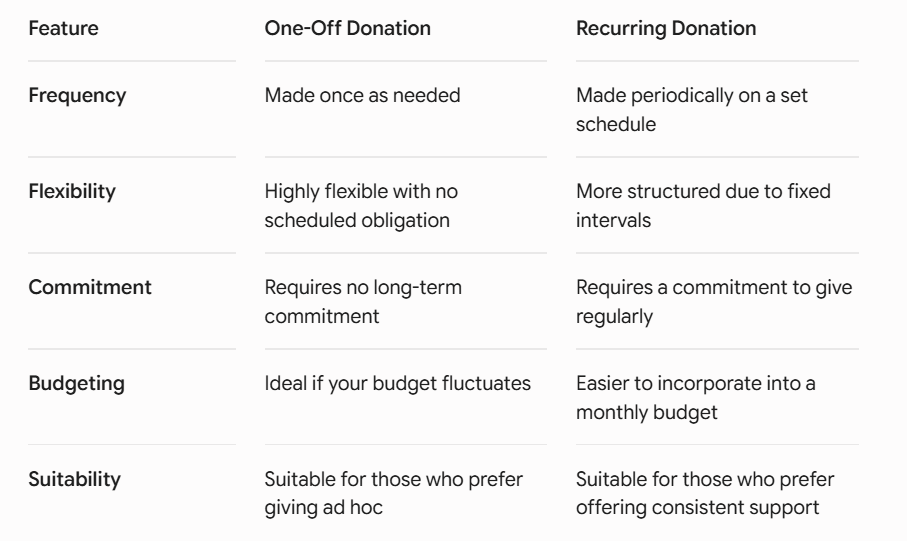
When Are One-Off Donations More Suitable?
One-off donations are ideal for individuals seeking maximum flexibility in managing their expenses. This approach enables you to choose the timing and amount of your gift based on your financial health, without being bound to a schedule.
This option is particularly suitable if your income is not fixed—for instance, if you work as a freelancer, run a start-up business, or experience fluctuating monthly earnings. It allows you to contribute whenever you have allocated funds available, free from concerns about long-term financial commitments.
Furthermore, a one-off donation can serve as an initial step for donors who wish to familiarise themselves with an organisation or programme first. Once they understand how the programme operates and feel confident in its management, some donors choose to transition to recurring giving. However, that decision remains entirely dependent on individual needs and readiness.
When Are Recurring Donations More Suitable?
On the other hand, recurring donations are more suited to individuals with a relatively stable income who wish to make giving an integral part of their monthly financial planning. Setting an amount from the outset allows you to maintain a consistent contribution without needing to complete manual transactions each time.
The key is to choose a realistic amount that can be comfortably sustained over time. There is no need to push for a large figure if it risks straining your essential needs or other financial goals. Consistent contributions made within your means are often far easier to sustain than large, one-off gifts that prove difficult to repeat.
Whichever pattern you select, ensure that your decision yields positive benefits for the supported programme while remaining aligned with your personal financial wellbeing.
How to Choose a Donation Pattern Within Your Means
There is no fixed rule dictating whether you should choose a one-off or a recurring donation. The best option is one you can comfortably maintain without disrupting your personal finances. Use the following checklist to guide your decision:
Assess your income stability: If your monthly income fluctuates, one-off donations may offer greater flexibility. Conversely, if your income is steady, a recurring donation may be easier to plan.
Prioritise essential needs: Ensure your day-to-day living expenses are fully covered before allocating funds to charitable giving.
Protect your emergency fund: Avoid using emergency funds or savings set aside for critical needs.
Define your giving goals: Do you want to contribute occasionally at specific moments, or provide sustained support to an educational programme? Your answer will help clarify the right option for you.
Review recurring donation terms: Before committing to regular giving, read the details regarding adjustments to donation amounts, payment schedules, and cancellation procedures to avoid future misunderstandings.
Review your budget periodically: Financial circumstances change over time. Re-evaluate your donation allocation regularly to ensure it remains within your means.
If you are uncertain about how much to give, you can also read our article on how small-value donations can still provide vital support to educational programmes when given consistently and within your budget.
Things to Check Before Setting Up a Recurring Donation
Before committing to a recurring donation, take time to learn about the programme you plan to support. This step ensures you understand how the organisation manages its work and guarantees that your giving decision is based on clear information.
Key points to verify include:
Programme goals: To understand the intended outcomes and the specific activities you will be funding.
Use of funds: A breakdown of how donation monies are managed in line with organizational policies.
Activity and progress reports: To evaluate the organisation’s transparency and accountability to the public.
Payment security: Confirming that donations are processed through official and secure channels.
Policy on altering donation amounts: To ensure you can adjust your contribution level in the future if needed.
Cancellation procedures: So you are clear on the steps required should you wish to stop your regular giving.
Checking these details is an essential part of selecting a programme that aligns with your expectations as a donor. This approach ensures you consider not only the method of giving, but also how the initiative is run and accounted for.
Summary
Both one-off and recurring donations play an equally vital role in supporting children’s education. One-off donations offer higher flexibility, whereas recurring donations suit those wishing to provide ongoing support within their means. There is no single correct choice; the best decision depends on your financial situation, donation objectives, and readiness to commit.
Having understood the differences between the two, the next step is to learn how to select programmes managed with transparency and accountability. Equipping yourself with this knowledge enables you to make well-informed giving decisions.
Now that you understand the differences between one-off and recurring donations, learn how to assess programme transparency and impact before choosing a sponsorship