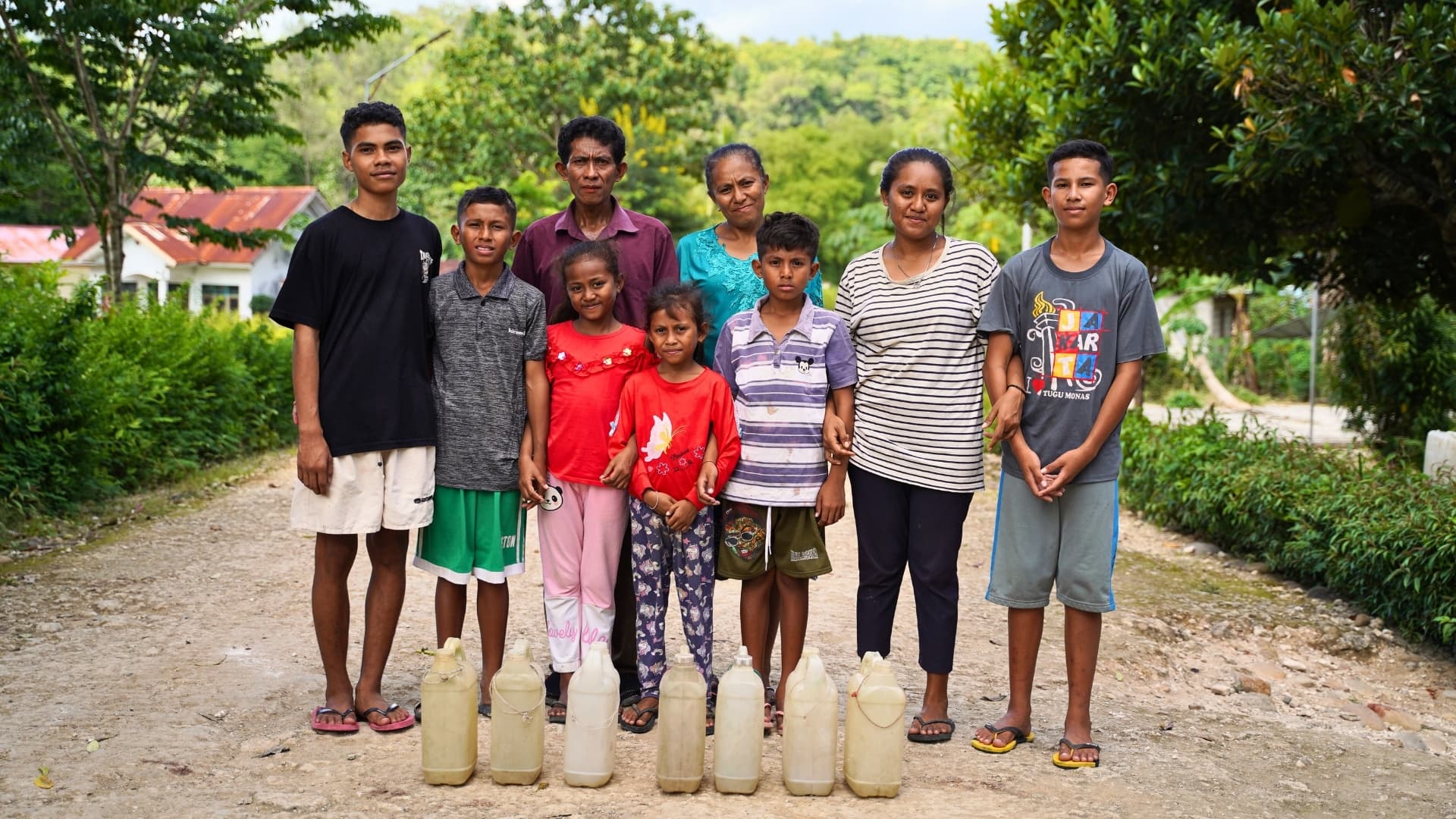
For generations, Distin's (8) family has endured the hardship of limited access to clean water. Even when Distin’s parents were children, clean water was a constant struggle. Today, this third-grade primary school student still has to fight to collect water from the river. There are still no taps providing clean water to the homes in her hamlet in the South Central Timor Regency.
“I want to have a tap at home so I can just get the water there,” Distin says. It is not uncommon for her school schedule and playtime to be disrupted because she has to fetch water for daily needs. “I’ve gone to fetch water at the river and ended up late for school, which made my teacher angry. Or when I’m busy playing and my father asks me to go get water, I feel annoyed,” she admits.
At home, she lives with her six siblings and her parents. Nine family members rely on clean water every day, especially Mama Netty (45), Distin’s mother. Household chores and farming require a significant amount of water.
“For me, we usually collect water for cooking, washing up, and the bathroom. If we’re washing clothes, we do it at the river during the dry season. As mothers, we need a lot of water. So, we have to collect quite a large amount for a single day. We need water every day, so every day we fetch it. The fetching never stops,” Mama Netty shares.
Fetching water from the river is a task for Distin and her siblings. Sometimes their father and mother help once their work in the farm is finished. With the strength of an eight-year-old girl, Distin finds carrying a five-litre jerry can very heavy. Furthermore, Distin’s family requires about 10 jerry cans a day. Even this is actually far from the World Health Organisation (WHO) health standards, which state that one person needs approximately 50 litres of water per day to avoid health risks. In reality, Distin and her family make do with roughly 50 litres of water for nine people per day.
“Recently, the government has been educating us on hygienic living. But when we try to live hygienically yet water is scarce, it means we aren't actually creating a clean life. We just stay the way we were before,” says Bapak Edi (48), Distin’s father. The knowledge and desire to start a clean and healthy life remain suppressed because the clean water has not yet arrived.
Collecting water from the river is no easy feat. Distin and her family have to dig for springs in the riverbed. During the dry season, these dug-out springs remain stable, but the situation changes completely during the rainy season. “The hardest part is the rainy season. We want to cook, but clean water is difficult to find because it’s covered by murky river water. To get clean water in the middle of the rainy season, we struggle immensely,” he explains.
The only solution Distin’s family has for clean water during the rainy season is to buy it. One jerry can, or five litres of clean water, is priced between 2,500 and 3,000 Rupiah. Bapak Edi usually buys only four to six jerry cans a day because this expense is a heavy burden for him as a farmer.
“If we buy three jerry cans for 10,000, that’s only for one day. It gets used up—it’s not even enough. We have to add another three. So in one day, it can be four, five, or even six jerry cans for the household needs. We buy it, but only for drinking water. Because the springs are often ruined by floods. So we have to buy drinking water, clean water. For washing, we can manage with rainwater,” says Bapak Edi.
The struggle for clean water for Distin and her family needs to end immediately. Distin and the other children in the same hamlet need urgent access to clean water so that they are no longer late for school and their playtime is no longer interrupted by fetching water from the river. Having clean water at home would finally allow Distin and her family to practice clean and healthy lifestyle.
“My hope is that there will be drinking water or clean water for us. To give us a little bit of joy and for our household needs. To stop us from constantly fetching water from the river. From the time I was a child until I married and had grandchildren, we have never enjoyed clean water,” Mama Netty concludes.
In this ENOUGH campaign moment, you can turn your donation into clean water for Distin, her family, and her community in South Central Timor. Click the link mywvi.id/enough to bring clean water to Distin’s home!
Author: Mariana Kurniawati (Communication Executive)