Providing children with financial support for school fees helps open access to education, but it is only one part of what is required for optimal learning. Beyond funding, a child's education is deeply shaped by nutrition, health, the learning environment, family support, and instructional quality. These factors are interconnected, meaning educational support must be viewed through a more holistic lens.
For us, understanding the multifaceted needs of a child's education is an essential first step before deciding how to contribute. By recognising the various elements that influence learning, readers can see that education is not just about attending school, but also about creating the right conditions to support a child’s long-term development.
School Fees Address Only One Aspect of Educational Needs
Financial aid for school fees plays a crucial role in keeping children in education. This support helps meet foundational needs tied to school access, such as tuition, uniforms, textbooks, and transport.
For many families, these expenses present a significant financial burden. Assisting with school fees helps alleviate this pressure, ensuring children have the opportunity to remain in school.
However, every child faces a unique set of circumstances. While some struggle financially, others face health challenges, a lack of learning facilities, or an unsupportive home environment. For this reason, funding for school fees should be viewed as one component of educational support, rather than the sole requirement.
Financial Support Keeps Children Connected to School
A key benefit of financial aid is ensuring children maintain uninterrupted access to classroom learning. This support helps cover daily educational necessities.
For instance, families may need to allocate funds for school transport, textbooks, replacement uniforms, or essential learning supplies. Naturally, these financial requirements vary depending on the family and the region.
Support should therefore be aligned with specific programme objectives so that it directly targets the actual needs of the beneficiaries.
Learning Needs Continue Beyond Financial Support
Even when school fees are taken care of, a child's educational journey is far from over. Children still require good physical health to stay focused, a safe environment in which to learn, family encouragement to stay motivated, and access to quality instruction.
In short, education relies on a web of interconnected needs. Meeting one need is important, but achieving better long-term outcomes generally requires addressing the broader set of factors that support a child's learning process.
Essential Educational Needs That Require Collective Support
To ensure learning is truly effective, several complementary areas of support must work together. Each plays a distinct role in fostering a child's educational development.
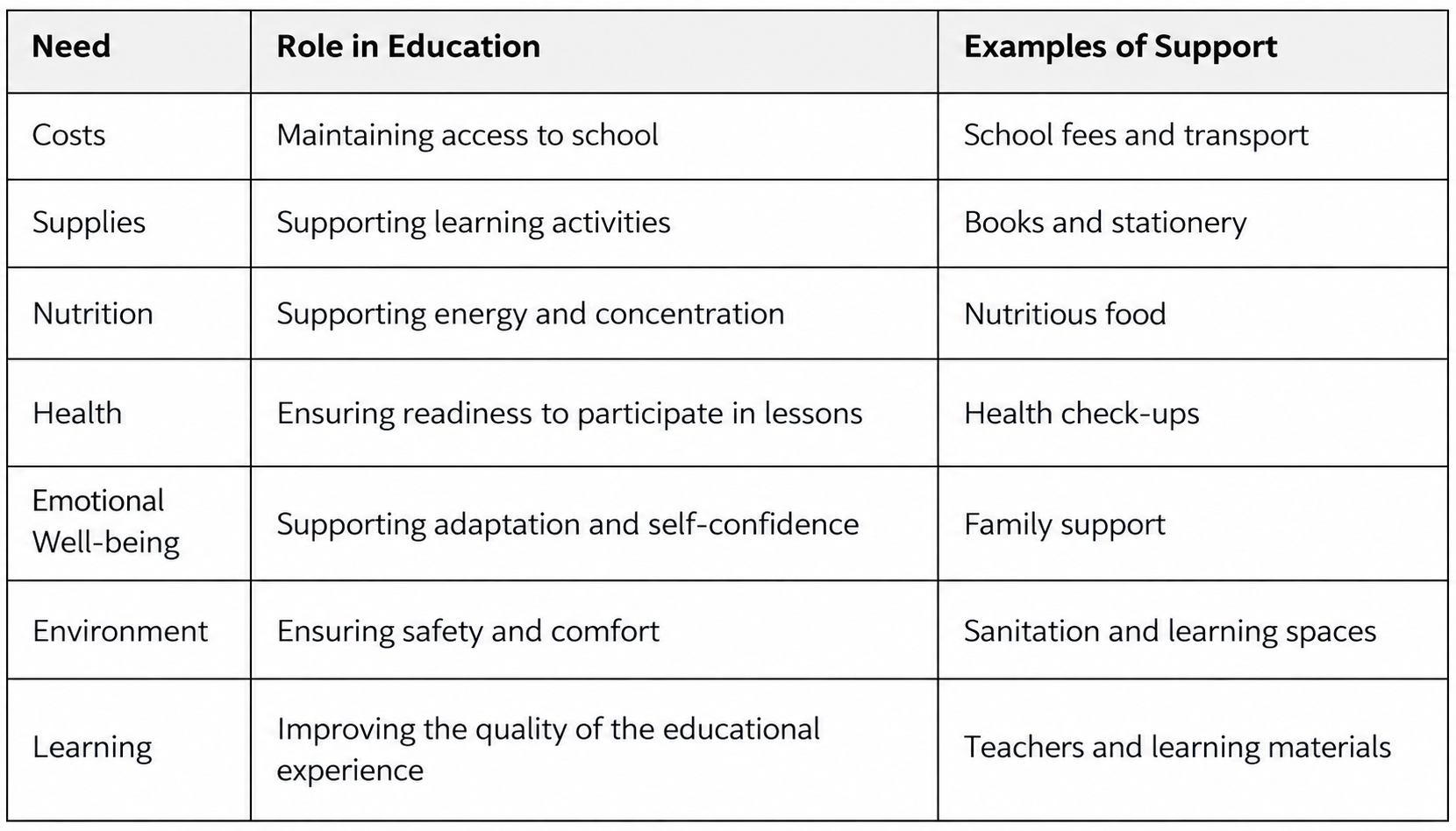
The table above shows that a child’s educational needs are not limited to school fees. Children also need adequate learning supplies, good health, emotional support, a comfortable environment, and quality learning opportunities. All these needs complement one another in helping children have a better learning experience.
Nutrition and Health Support Readiness to Learn
Good physical health helps children participate more effectively in learning activities. Nutritious food provides the energy they need for daily activities, while maintaining good health can support their concentration throughout the learning process.
Regular health check-ups and healthy habits also contribute to children’s readiness to attend school and participate in learning activities more consistently. However, every child has different health needs, so the type of support required may vary.
Learning Supplies Help Children Participate in Education
Learning supplies such as books, stationery, school uniforms, bags, and other educational materials help children participate in education more comfortably. The type of supplies needed may vary depending on the child’s level of education, school conditions, and where they live.
When learning supplies are available, children have better opportunities to participate in a range of learning activities. Therefore, learning supplies are one of the elements that complement financial assistance for school costs in supporting a child’s education.
The Learning Environment Influences a Child’s Experience
In addition to learning supplies, the learning environment also affects children’s comfort and ability to continue their education. Adequate learning spaces, proper sanitation, access to clean water, and access to technology can all help create a more conducive learning environment.
In some areas, limited facilities remain a challenge that affects children’s learning experiences. For example, uncomfortable learning spaces or limited internet access can hinder certain learning activities. This shows that the quality of the learning environment is also an important part of a child’s educational needs that deserves attention.
Emotional Support Helps Children Adapt
Learning is influenced not only by academic ability but also by a child’s emotional well-being. A sense of safety, self-confidence, and support from those around them can help children feel more prepared to face the various challenges they encounter throughout their education.
Families play an important role in providing encouragement and developing positive learning habits at home. At school, teachers and peers can also create a supportive environment where children feel comfortable asking questions, discussing ideas, and developing their potential. This kind of emotional support helps children adapt to their learning environment and maintain their motivation to continue growing.
Teachers and Learning Materials Shape the Quality of Education
Access to school is an important first step, but the quality of learning also determines how children gain knowledge and skills. Teachers, learning materials, libraries, and other educational resources all contribute to creating a more meaningful learning experience.
When learning takes place effectively, children gain not only knowledge but also opportunities to develop their thinking, communication, and problem-solving skills. Therefore, the quality of learning is another important aspect that complements the various forms of educational support children need.
Why Educational Support Needs to Be Comprehensive
Various barriers to education are often interconnected. Meeting one need can certainly help, but it may not address other challenges a child faces.
For example, a child may have adequate books and school supplies. However, if they are frequently unwell, their opportunities to attend lessons may still be reduced. Conversely, a healthy child may also experience difficulties learning if access to school is limited or their learning environment is not supportive.
For this reason, comprehensive educational support seeks to consider the connections between different needs, rather than focusing on just one aspect.
Educational Barriers Can Affect One Another
Economic circumstances, health, access to facilities, and the quality of learning can all influence one another. Challenges in one area can often have an impact on other areas.
For example, financial constraints may affect a family’s ability to meet a child’s educational needs. At the same time, poor health can result in a child missing school more frequently, disrupting their learning. These connections demonstrate that education is a process influenced by a range of interrelated factors.
Ongoing Support Helps Sustain Children’s Development
Children develop gradually, and their needs can change over time. Therefore, educational programmes generally require monitoring and evaluation to ensure that activities remain aligned with their intended objectives.
Through monitoring, programme implementers can assess progress while also adapting their approach when needs on the ground change. Ongoing support helps ensure that assistance does not stop after a single activity, but continues to respond to children’s evolving needs.
How to Assess Comprehensive Educational Support for Children
Before choosing a donation programme, you can use the following simple checklist to evaluate the scope of a programme:
Is the purpose of the education programme clearly explained?
Are the target beneficiaries clearly and openly described?
Does the programme address more than one educational need, such as health, learning supplies, or the learning environment?
Is the duration of the programme clearly explained?
Are programme reports or updates available?
Is information about the organisation and its contact details easy to find?
This checklist can help you compare different programmes more objectively. By understanding their scope, objectives, duration, and reporting, you can choose a programme that aligns with your concerns and the impact you hope to support.
Learn About the Connection Between Education and Children’s Health
You now know that supporting a child’s education is not only about school fees. It is also influenced by nutrition, health, the learning environment, emotional support, and the quality of education. All these needs complement one another in helping children have better opportunities to learn.
A child’s educational needs are closely connected to their health and development. Next, explore how child sponsorship donations can support education and health to understand how these two areas can work together to support children’s development over the long term.