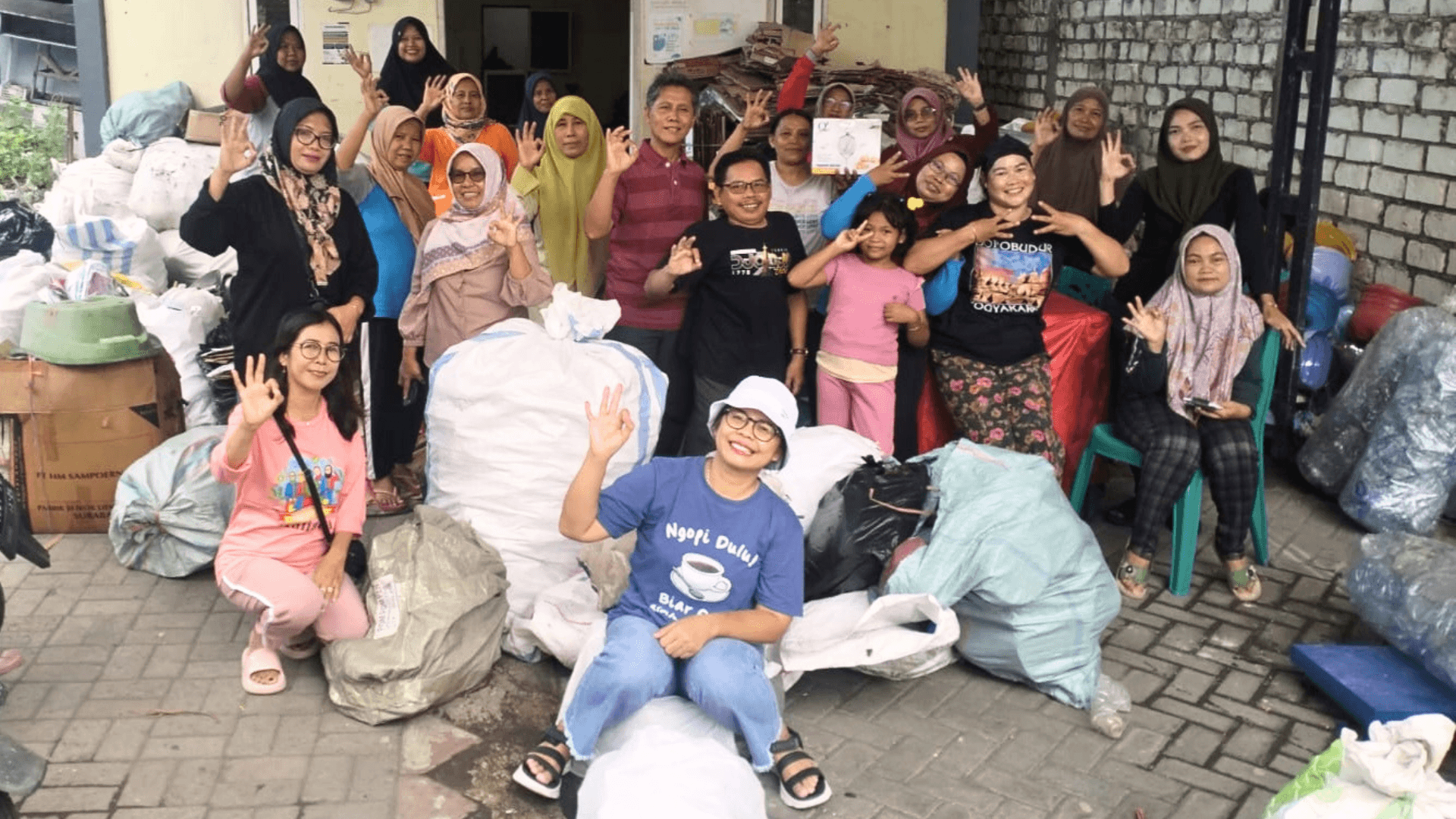
Waste remains a major issue in Surabaya. However, a significant shift in waste management within a village supported by Wahana Visi Indonesia (WVI) began in September 2025. It all started when Fitri (48) participated in a comparative study on waste bank management in Karawang and Bekasi, organised by WVI.
Inspired by the experience, she conceived the idea of unifying the community's fragmented waste management efforts by establishing a Main Waste Bank at the RW (community association) level. Through socialisation, mentoring, and collective community action, this movement has steadily grown, bringing changes to the environment.
"When I returned from the visit, I saw a situation that actually held great potential but wasn't being managed properly. The area consists of 18 RTs (neighbourhood units), but at the time, there were only three waste banks at the RT level. Activities were disjointed, uncoordinated, and lacked a clear management system. That’s where the simple idea came from: what if we united all these movements?" Fitri explained.
With this vision, the Main Waste Bank was established as a coordination hub. The goal was not just to collect waste, but to align community efforts so they would be more focused, mutually supportive, and able to grow together.
The journey wasn't without its hurdles. In the beginning, not all residents understood the importance of sorting waste; many still viewed it as worthless. Participation levels fluctuated, and coordinating across different RTs took time as people weren't accustomed to working within an interconnected system.
"I am so grateful to WVI for their constant support—from training us in waste sorting and bookkeeping to being a partner we can consult whenever problems arise," she added.
The approach to the community was gradual. Through consistent education and mentoring, residents were encouraged to view waste through a different lens: not as something to be discarded, but as a resource to be managed with economic value.
RTs that were previously inactive began to show interest, eventually forming their own waste banks. A sense of collective spirit took root as residents started to reap the benefits.
From November 2025 to May 2026, the progress has been heartening:
Expansion: Grown from 3 original waste banks to 15 active RT-level waste banks, plus participation from local schools.
Wider Impact: The movement has attracted interest from other villages, with some residents now depositing their sorted waste at the Main Waste Bank via local mosques.
Volume: Between November 2025 and March 2026, the bank managed a total of 5.2 tonnes of waste.
Economy: On average, they collect 1.3 to 1.5 tonnes per month, generating a monthly turnover of £50 to £75 (Rp 1,000,000 - Rp 1,500,000) from active members and waste donations.
Participation: Active members reached 604 people by February 2026.
Beyond the numbers, the most significant change lies in the community’s mindset. The neighbourhood is now tidier, the volume of waste collected by carts has decreased, and residents recognise the financial value of their rubbish.
Fitri hopes that, in the future, the Main Waste Bank will evolve into more than just a collection point—becoming a hub for environmental education and community economic empowerment. She hopes this movement inspires other regions to create cleaner, more organised, and sustainable environments.
"For us, the waste bank isn't just a place to 'save' rubbish; it has become a movement for change. Something once considered worthless has become a blessing—a way to build awareness, togetherness, and hope for a better environmental future," Fitri concluded. "This process has fostered care, developed personal potential, and encouraged a real contribution to our local environment. From this, community awareness and the spirit of mutual cooperation continue to grow. Thank you, WVI, for the guidance and partnership you have provided."
Author: Andi Nugroho (WASH Officer in Simokerto Area Programme)
Editor: Mariana Kurniawati (Communication Executive)