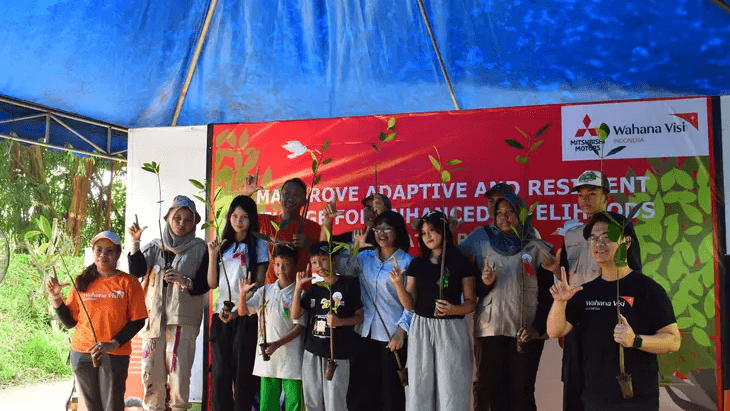
GNFI, Jakarta - The climate crisis and the decline in environmental quality in Jakarta have become increasingly evident in recent years. Recurring tidal flooding is one clear indicator of this. Throughout 2024, Jakarta’s coastal areas experienced flooding of up to 60 cm, as reported in the scientific publication Globe 2025.
These conditions underscore the urgency of interventions that are not only short-term but also sustainable. In this context, Wahana Visi Indonesia (WVI) launched the Mangrove Adaptive and Resilient Village Project for Enhanced Livelihoods Jakarta (MARVELJAK) as part of efforts to restore and strengthen the resilience of coastal areas.
The MARVELJAK program will run from 2025 to 2030 with funding support from the Mitsubishi Motors STEP funds, which are sourced from contributions by Mitsubishi Motors Group employees, as well as a matching gift program from Mitsubishi Motors Corporation. This initiative prioritizes coastal ecosystem rehabilitation while integrating a social approach through community engagement, particularly among the younger generation.
Mangrove Rehabilitation as the Foundation for Adaptation
One of the main focuses during the early phase of the program’s implementation was mangrove planting as a step toward ecosystem rehabilitation. From November 2025 to April 2026, a total of 18,300 mangrove seedlings were planted in Jakarta’s coastal areas. This effort did not stop at planting; it was also accompanied by periodic growth monitoring to ensure the effectiveness of the rehabilitation.
This step is crucial given that Jakarta’s environmental quality remains below the national average. The DKI Jakarta Environmental Quality Index (IKLH) in 2024 stood at 56.39, far below the national figure of 73.53. These figures place Jakarta among the provinces with the lowest environmental quality in Indonesia. In this situation, mangroves serve as a natural barrier capable of reducing the impact of coastal erosion, mitigating tidal waves, and enhancing the resilience of coastal areas to climate change.
Environment and Child Protection
The MARVELJAK program also highlights the direct link between environmental conditions and children’s well-being. Johny Noya, WVI’s Zone Program Manager for Java and Sumatra, emphasized that coastal environmental issues cannot be separated from child protection.
He stated, “A degraded environment directly affects children’s health, sense of security, and quality of growth and development. When tidal flooding occurs repeatedly and coastal ecosystems weaken, children are the group most severely impacted, both physically and psychosocially. For this reason, the MARVELJAK Program is here to ensure that environmental adaptation and recovery efforts proceed sustainably to fulfill children’s fundamental right to grow up in a safe and comfortable environment.”
This statement underscores that the impacts of the climate crisis are not only ecological but also social. Children living in coastal areas face higher risks, ranging from health issues to psychosocial stress resulting from unstable environmental conditions. Therefore, an approach that integrates child protection is a crucial component of this program’s design.
Young People Play a Role
In addition to physical rehabilitation, MARVELJAK also prioritizes an educational approach by directly engaging the younger generation. As part of one of its activities, the program invited 100 middle and high school students who are members of the Children’s Forum at the subdistrict and village levels to participate in a mangrove education event titled “Know, Love, Preserve: Mangroves for the Future” at the Angke Kapuk Protected Forest.
This activity was designed using a participatory method that combines interactive learning, field observations, and hands-on mangrove planting. Through this approach, students not only gain knowledge about the ecological functions of mangroves but also understand the connection between environmental sustainability and their future. This engagement is expected to foster awareness from an early age while encouraging sustainable behavioral change.
Collaboration for Sustainability
The implementation of MARVELJAK reflects the importance of cross-sector collaboration in addressing the challenges of climate change. The partnership between Wahana Visi Indonesia, the Mitsubishi Motors STEP funds, and Mitsubishi Motors Corporation serves as an example of how the non-governmental and private sectors can contribute to environmental restoration efforts.
This collaboration focuses not only on short-term results but also on building long-term commitment. By involving the younger generation as part of the solution, this program aims to foster a sense of ownership of the coastal environment. This approach is expected to strengthen community resilience while ensuring that children in Jakarta have the opportunity to grow and thrive in a safer and healthier environment amid the ongoing challenges of climate change.